
My MRI Shows a Herniated Disc. Can My Back Pain Still Be the Nervous System?
Nov 09, 2026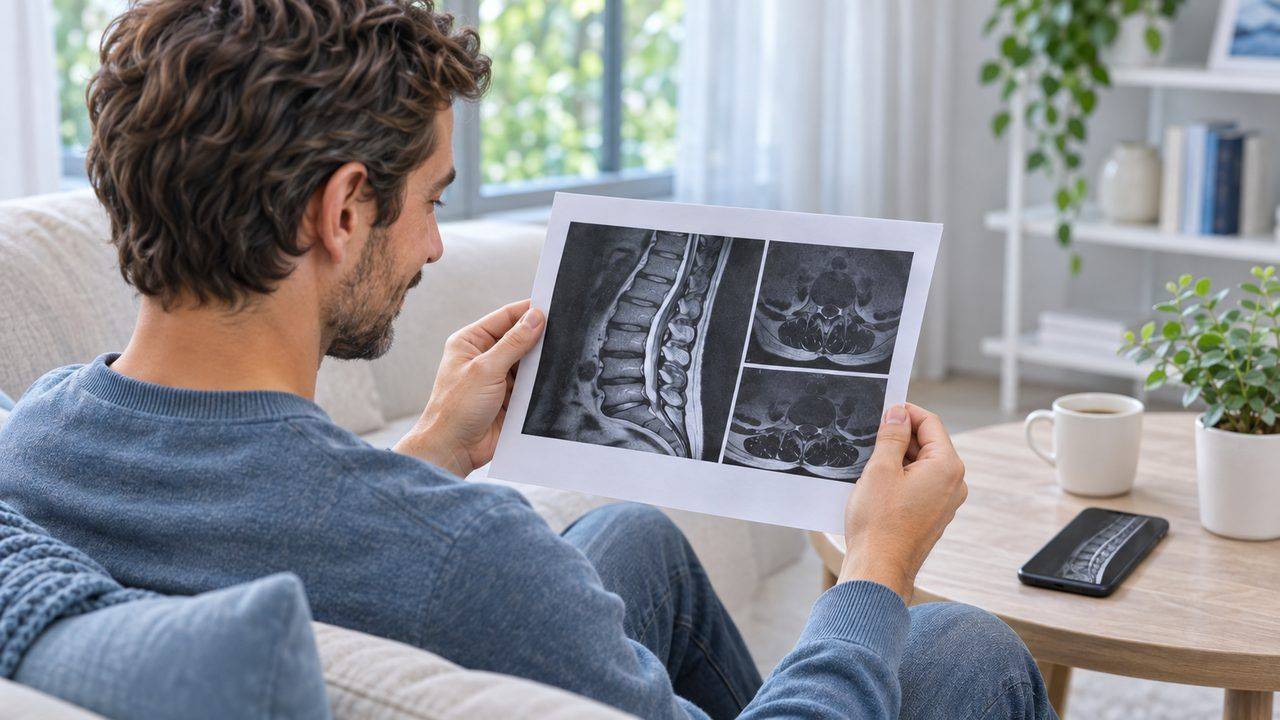
By Dr. Nate Feehrer, PT, DPT (Doctor of Physical Therapy, B.S. in Neuroscience)
Yes. A herniated or bulging disc on your MRI does not automatically mean that disc is what's causing your pain today. Disc bulges and protrusions show up on the scans of many people who have no back pain at all, and when pain lasts for months or years, a sensitized nervous system is often a big part of what keeps it going.
That doesn't mean your disc doesn't matter. It means your MRI is one piece of the picture, not the whole thing.
I know how scary that MRI report can feel. I lived with an L4-L5 disc herniation and four years of back pain before I built BackUnbroken. Here's what the research actually says, and what it means for you.
Key takeaways
- Disc bulges and protrusions are common in people with zero back pain, and they get more common with age.
- Many herniated discs shrink on their own over time, and the bigger ones are actually more likely to shrink.
- Long-lasting pain is often kept going by a sensitized nervous system, even after tissue has healed.
- Your pain is real either way. Nervous system pain is not "in your head."
- A few symptoms need a doctor right away. Know them before you try any program.
How common are disc herniations in people with no back pain?
Much more common than most people think. In a well-known study in the New England Journal of Medicine, researchers scanned 98 adults who had no back pain. Only 36% had normal discs at every level. 52% had a disc bulge at one level or more, 27% had a protrusion, and 1% had an extrusion.
A larger review in the American Journal of Neuroradiology pooled 33 studies covering 3,110 people without back pain. Disc bulges showed up in 30% of 20-year-olds and 84% of 80-year-olds. Disc degeneration went from 37% at age 20 to 96% at age 80. The authors concluded that many of these findings are likely part of normal aging and not linked to pain.
So if you're an adult and you get an MRI, there's a good chance it shows something. The real question is whether that something explains the pain you have now.
If my disc isn't the whole story, why does my back still hurt?
Tissue heals, but the pain alarm can stay turned up. Pain is your nervous system's alarm. After an injury, that alarm is useful. It makes you protect the area while it heals. But when pain goes on for months or years, the alarm itself can become more sensitive, firing at normal movements that aren't actually dangerous.
Pain scientists have names for this. The International Association for the Study of Pain defines central sensitization as increased responsiveness of pain-processing neurons in the central nervous system. It also recognizes nociplastic pain: pain that comes from altered pain processing without clear evidence of tissue damage driving it. IASP notes that people can have a combination of tissue-based and nociplastic pain at the same time.
That last part matters for disc pain. It's rarely all disc or all nervous system. Often an injury started it, and a protective, sensitized nervous system is what keeps it going.
Signs your nervous system is playing a big role
- Your pain has lasted well past normal healing time.
- Your pain changes with stress, sleep, or mood, not just with what you did that day.
- The same movement feels fine one day and terrible the next.
- You brace before bending, check in with your back all day, and avoid movements that feel risky.
If several of these sound like you, it's a strong sign that calming your nervous system is part of the solution.
Can a herniated disc heal on its own?
Often, yes. A systematic review in Clinical Rehabilitation looked at 31 studies of people with lumbar disc herniations treated without surgery. Herniated disc material regressed on its own in 96% of sequestrations, 70% of extrusions, 41% of protrusions, and 13% of bulges. It fully resolved in 43% of sequestrated discs and 15% of extruded discs.
Notice the pattern. The more dramatic the herniation looked, the more likely the body was to reabsorb it. That's the opposite of what most people expect, and it's one reason a scary report doesn't have to mean a scary future.
Does a nervous system approach actually work for back pain?
The research is encouraging. In a randomized trial published in JAMA Psychiatry, 151 adults with chronic back pain were assigned to pain reprocessing therapy, a placebo injection, or their usual care. After four weeks, 66% of the pain reprocessing group were pain-free or nearly pain-free, compared with 20% in the placebo group and 10% in usual care. Most of those gains held at one year.
A five-year follow-up found that 55% of the pain reprocessing group were still pain-free or nearly pain-free, compared with 26% in the placebo group and 36% in usual care.
To be clear, those studies tested pain reprocessing therapy, not BackUnbroken, and most participants had low to moderate pain. But they support the same core idea BackUnbroken is built on: when you change how your nervous system reads pain and movement, chronic back pain can get a lot better.
Does this mean my pain is "in my head"?
No. Your pain is 100% real. IASP defines pain as "an unpleasant sensory and emotional experience associated with, or resembling that associated with, actual or potential tissue damage," and it points out that pain and the signals from your tissues are different things. Your brain and nervous system produce every pain you've ever felt, from a stubbed toe to a disc injury. Saying the nervous system is involved is just describing how pain works.
When should I see a doctor before trying a program?
Before assuming your pain is mostly nervous system related, get checked by a doctor to rule out anything serious. Go to an emergency department right away if you notice any of these, which can be signs of cauda equina syndrome, a rare but serious condition:
- Numbness or pins and needles between your inner thighs, around your genitals, or around your bottom
- New difficulty starting, stopping, or controlling your urine
- Loss of bowel control or loss of feeling when you go to the bathroom
- Weakness or numbness in both legs that is severe or getting worse
Also get checked after a major trauma like a fall or car accident.
What actually helps when you have a disc finding and chronic pain?
You need to work on both sides: the nervous system that's keeping the alarm turned up, and the body that's lost strength and confidence from years of guarding. That's exactly how BackUnbroken is built, in three phases:
- Reframe. Understand what your pain is and isn't telling you, so a disc finding stops feeling like a life sentence.
- Rewire. Calm an overprotective nervous system with techniques like breathwork, relaxation, and gentle exposure to movements you've been avoiding.
- Restore. Rebuild strength and mobility step by step, at your pace, so your back can handle real life again.
It takes about 15 minutes a day, from home, with no equipment. You can do it in the BackUnbroken app on the App Store or Google Play, or on your computer. It's built on the same concepts that got me out of my own four years of back pain, and we've worked with countless members carrying this exact diagnosis. You can read some of their stories on our testimonials page.
If you want the bigger picture of how the nervous system keeps pain going, read The Real Cause (and Solution) of Chronic Back Pain. And if you have questions about how the program works, our FAQ page answers the most common ones.
Ready to see what's possible for your back?
Not sure if BackUnbroken is a good fit for your situation? Take the Free Assessment. It takes less than 2 minutes. When you're ready, start your 5-day free trial. You can cancel anytime during the trial, and you won't be charged.
Frequently asked questions
Can a herniated disc cause back pain for years?
It can, but long-lasting pain usually isn't just the disc. Many herniations shrink on their own over time, while a sensitized nervous system can keep pain going long after the tissue has calmed down. That's why BackUnbroken works on calming the nervous system and rebuilding strength, not just on the disc.
Does a bulging disc on my MRI always cause pain?
No. Disc bulges are very common in people with no back pain at all, and they become more common with age. In one large review, bulges showed up in 30% of pain-free 20-year-olds and 84% of pain-free 80-year-olds. A bulge on your MRI may or may not be related to your pain.
Can I do BackUnbroken if I have a herniated disc?
Yes. BackUnbroken helps you calm the overprotective pain response, rebuild trust in movement, and progressively restore strength and tolerance, even if your imaging shows disc involvement. You start with education before any movement, and every step is under your control. Check with your doctor first if you have any red flag symptoms.
Will my herniated disc heal without surgery?
Often, yes. A systematic review of 31 studies found that herniated disc material regressed on its own in 70% of extrusions and 41% of protrusions, with even higher rates for larger sequestrated herniations. Your doctor can tell you whether your situation needs a surgical opinion.
This article is for educational purposes only and is not a substitute for professional medical advice. Talk to your healthcare provider before making any treatment decision.
